Page Not Found
Page not found. Your pixels are in another canvas.

A variety of common markup showing how the theme styles them.
Single line blockquote:
Quotes are cool.
| Entry | Item | |
|---|---|---|
| John Doe | 2016 | Description of the item in the list |
| Jane Doe | 2019 | Description of the item in the list |
| Doe Doe | 2022 | Description of the item in the list |
| Header1 | Header2 | Header3 |
|---|---|---|
| cell1 | cell2 | cell3 |
| cell4 | cell5 | cell6 |
| cell1 | cell2 | cell3 |
| cell4 | cell5 | cell6 |
| Foot1 | Foot2 | Foot3 |
Make any link standout more when applying the .btn class.
Watch out! You can also add notices by appending {: .notice} to a paragraph.
This is an example of a link.
The abbreviation CSS stands for “Cascading Style Sheets”.
“Code is poetry.” —Automattic
You will learn later on in these tests that word-wrap: break-word; will be your best friend.
This tag will let you strikeout text.
The emphasize tag should italicize text.
This tag should denote inserted text.
This scarcely known tag emulates keyboard text, which is usually styled like the <code> tag.
This tag styles large blocks of code.
.post-title {
  margin: 0 0 5px;
  font-weight: bold;
  font-size: 38px;
  line-height: 1.2;
  and here's a line of some really, really, really, really long text, just to see how the PRE tag handles it and to find out how it overflows;
}
Developers, developers, developers…
–Steve Ballmer
This tag shows bold text.
Getting our science styling on with H2O, which should push the “2” down.
Still sticking with science and Isaac Newton’s E = MC2, which should lift the 2 up.
This allows you to denote variables.
Page not found. Your pixels are in another canvas.
This is a page not in th emain menu
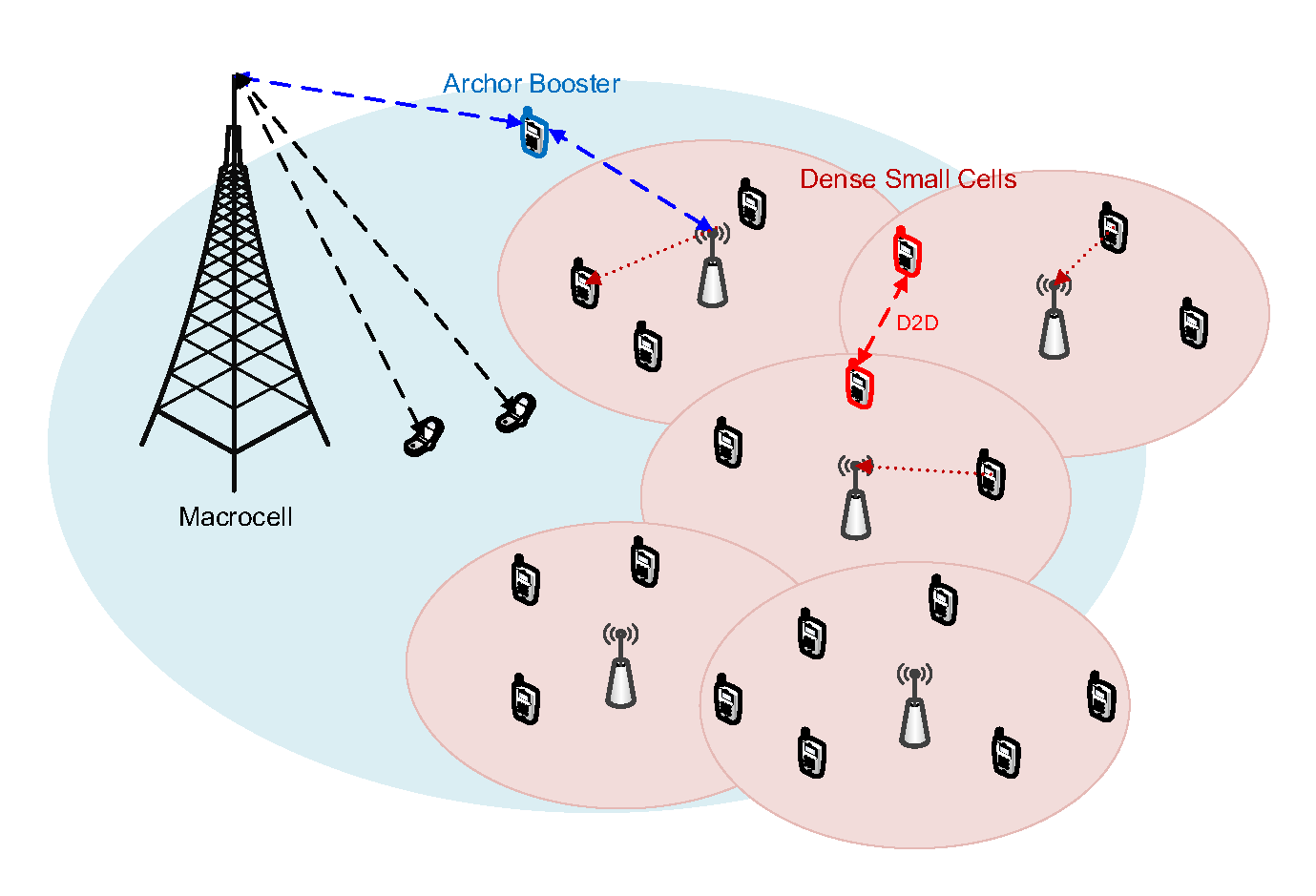
The objective of this project is to mitigate the interference in device-to-device (D2D) communications that are underlaid in and coexist with cellular communications from a resource management perspective. Using game theory, we first designed a resource allocation mechanism for intercell D2D communications. Specifically, the problem in which two base stations located in two neighboring cells compete for bandwidth allocation quote to a D2D link appearing in the overlapping area of the two adjacent cells was investigated. This investigation was then extended to a new one where the game information was incomplete. It is worth noting that the extended version revealed a better performance than the previous version (with complete/perfect information) in terms of sum rate and that it is more realistic in the sense of matching real-world scenarios. In addition to the spectrum resources allocation, we also explored the issue of how to reduce the interference to cellular users and prolong the lifetime of the user devices in parallel by controlling the user devices’ power. A power control algorithm was subsequently devised in the presence of simultaneous wireless information and power transfer technique, which empowers the devices to transmit data and harvest energy simultaneously. Regarding how to use the harvested energy, a slew of online energy scheduling policies was developed based on the arrival properties of energy signals.
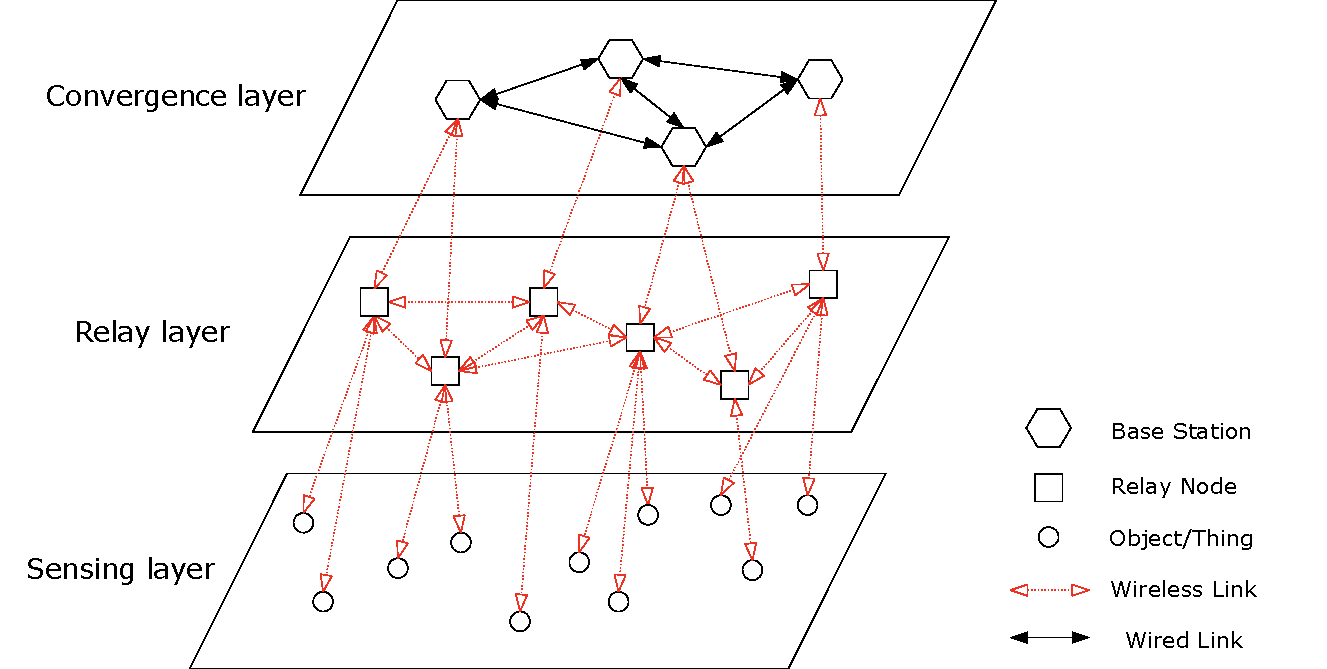
The goal of this project is to establish a spectrum of mechanisms to manage the Internet of Things (IoT) effectively and efficiently. Since the things are typically wireless sensors or RFID tags, which all have limited computing power and energy capacity, we started by proposing an energy-efficient hierarchical IoT architecture design. Since the proposed architecture does not require sensors equipped with sophisticated modules and runs complex routing mechanisms, it is expected to be flexible, scalable, and manageable. To deal with the potential chaos of medium access caused by massive machine-type communications, we presented an access control mechanism to ensure the quality of services and the sustainability of IoT systems in smart cities. We also developed a lightweight and cost-effective multicast routing algorithm for multimedia communications in IoT systems. A network-coding-based, relay-assisted, and bi-directional data transmission scheme was formulated as to the efficiency of data transmissions in IoT systems. Interestingly, this scheme reveals the following fact: the time-varying feature of the state information of the wireless channel between two IoT objects can be utilized in the network coding technique to achieve a specific system performance gain.

This project aims to improve the end-to-end performance of Cloud service delivery and the quality of experience for end users. To this end, we first presented two service models – the communication-as-a-service (CaaS) model and networking-as-a-service (NaaS) model, and then proposed a network-Cloud service provisioning architecture. In this architecture, CaaS and NaaS models allow communication and networking resources to be virtualized, exposed as services, and integrated with Cloud computing resources resulting in a framework of composite network-Cloud services. New service composition algorithms were designed, analyzed, and tested in congruence with the proposed architecture. The testing results show that these new algorithms are effective and resilient in selecting services for the network-Cloud service composition and in guaranteeing the end-to-end performance of the composite service provisioning. As a step toward real-world applications, we implemented a network-Cloud content-sharing system by leveraging the paradigm of software-defined networks (SDN) on the Internet. Other associated research topics, such as the controller placement in SDN and the competition among network/Cloud service providers, were thoroughly investigated during the implementation process.